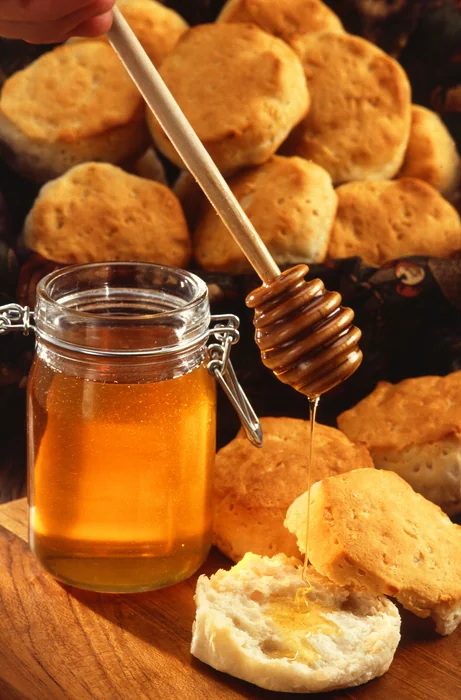
Honey the way the research actually studies it: a jar and a spoon. Photo: USDA Agricultural Research Service (public domain, image K7240-6).
The "Honey Trick" Ads, Fact-Checked
A long video promises a honey ritual that takes seconds and fixes memory, or energy, or both. The recipe never arrives; a checkout for capsules or gummies does. On October 7, 2026 we opened three of those funnels, read each product's ingredient list, and set the claims beside what honey contains and what the research says.
The three honey-named products sold at the end of these videos are a seven-ingredient botanical capsule, an amino-acid capsule and a six-ingredient gummy. Not one lists honey. Whatever the video promised about a spoonful, the item in the cart is a blend that, in one seller's own words, "has not been independently tested in clinical trials."
How the "honey trick" ad works
The ads change brand names more often than anything else. A long video, usually dressed as a news segment or a doctor's lecture, opens with a promise: a "honey trick," a "seven-second honey ritual," a three-ingredient spoonful your grandmother supposedly knew. One version targets older viewers worried about their memory and says the ritual brings it back within days; the version aimed at men promises everyday energy and vitality from the same spoonful. Both insist the recipe is coming, often hint that someone wants the video taken down, and run twenty minutes or more. The recipe never arrives. What arrives is a bottle with "honey" in the name and a page offering two, three or six of them.
Scam-tracking sites and a Better Business Bureau warning have documented the same mechanics under a rotating cast of brand names since at least early 2026, and the presenters are routinely AI-generated likenesses of real public figures with no connection to any product. We are not naming those people; borrowing a familiar face is the ad's trick. The shape is what matters: a free "trick" as the hook, a supplement as the payload, urgency as the close.
What honey actually contains
Honey is a concentrated sugar solution that bees make from flower nectar. The U.S. Department of Agriculture's reference entry puts it at about 82 grams of carbohydrate per 100 grams, nearly all of it fructose (about 41 g) and glucose (about 36 g), with water making up about 17 percent of the weight, a trace of protein and no fat. A level tablespoon weighs about 21 grams, so it carries around 64 calories and 17 grams of sugar. Spoon for spoon that is more than table sugar, not less, because honey is denser.
What makes honey honey rather than syrup is the small remainder. A 2008 review from the Swiss Bee Research Centre lists it: after the carbohydrates come "small amounts of proteins, enzymes, amino acids, minerals, trace elements, vitamins, aroma compounds and polyphenols," plus about 25 minor sugars. The same review reports a glycemic index from 32 to 85 depending on the flowers the bees visited, a polite way of saying "honey" is not one thing. Vitamin content is negligible: half a milligram of vitamin C per 100 grams in the USDA entry, with potassium at about 52 milligrams.
"Raw" has no official federal definition in the United States. In practice it usually signals honey that has not been heated much or finely filtered; "unfiltered" honey has been strained of wax and debris but not pushed through fine filters, so more pollen stays in. Neither word changes the sugar content.
What the research on honey really shows
There is real research on honey. It is about other things than the ads claim, and more modest than its headlines.
Short-lived coughs in children
Cochrane's 2018 update combined six randomized trials covering 899 children between 12 months and 18 years old. Honey "probably reduces cough frequency" better than no treatment or placebo (moderate certainty) and performed about as well as dextromethorphan (low certainty). Most of the children got honey for a single night, and the authors still describe "no strong evidence for or against" its use.
Honey inside an ordinary diet
A 2023 systematic review in Nutrition Reviews pooled 18 controlled trials (1,105 participants) in which people ate honey daily for at least a week. Fasting glucose fell by 0.20 mmol/L and total cholesterol by 0.18 mmol/L, both rated low-certainty, with raw, clover and robinia honeys showing the clearer effects. The authors' own framing: honey is a free sugar, and any benefit sits "within a healthy dietary pattern."
20 grams a day for 16 weeks
The only controlled memory trial we found gave 102 postmenopausal women in Malaysia 20 grams a day of Tualang honey, a specific wild-harvested variety, for 16 weeks. Immediate recall on a word-list test improved against an untreated group; delayed recall did not. A 2024 crossover trial in 66 healthy adults who ate yogurt with honey for two weeks found "mood and cognition did not differ" from control.
Honey behaves like other carbohydrates
A 2019 systematic review of nine exercise studies found honey taken around a workout produced performance and perceptual responses similar to other carbohydrate sources, with a benefit only against carbohydrate-free comparisons. That is the honest "energy" story: honey is sugar, and sugar is fuel.
On the men's-vitality version we found nothing to cite: no controlled human trial of honey for the outcomes those videos promise. The botanicals in the men's capsules and gummies have literatures of their own, about other outcomes, doses and populations; none studied the finished blend.
Why the ritual claims don't follow
- No trial has tested a timed ritual. The memory study used 20 grams of one honey daily for four months. Nothing in the literature involves seven seconds, a time of day or a secret pairing. The number in the ad is a hook, not a dose.
- The product is not honey. Even if a spoonful did what the video says, the capsule in the cart lists botanicals, amino acids or both. The research being borrowed is about a food the product does not contain.
- Ingredient studies are not product studies. The citation images on these pages point to papers on single ingredients at their own doses. One seller's FAQ concedes the finished formula "has not been independently tested in clinical trials"; we found nothing to contradict that for any of the three.
- "Brings memory back" is a disease claim a supplement cannot make. Federal law lets a supplement describe support for normal function, not cure or reversal of a condition, and no supplement gets an FDA sign-off before it goes on sale. A page saying otherwise is misstating the law.
- The only seven-second effect of honey is taste. A spoonful is roughly 17 grams of sugar, used as fuel over the next hour or two like any other sugar. No mechanism turns that into a memory or vitality effect on a timer.
Funnel red flags, as seen on October 7, 2026
We opened the live sales pages of the three products that day. We name the pattern rather than link the pages, deliberately; everything below is what their own pages display.
| What the page shows | Why it matters |
|---|---|
| Identical price tiers on all three: 2 bottles for $158, 3 for $207, 6 for $294, each beside a crossed-out "compare" total of $298 to $1,074. | One price sheet shared to the dollar points to one template, not three companies. We found no record of anyone paying the crossed-out figures. |
| "Join 94% of customers who choose the 6-bottle pack"; "available only while supplies last"; three "free" e-books "worth" $47, $57 and $37. | Unsourced social proof, manufactured urgency and bonus padding exist to stop you reading further. |
| A trust badge asserting FDA approval, and an FAQ answer stating the capsules are approved by the agency before being marketed. | False as written. The FDA does not approve dietary supplements before sale; it can register a facility, which is a routine filing. |
| "Rated 5.0/5" from "44,628 reviews" with no way to read one; testimonials typed into the page with "Verified Purchase" badges. | Unverifiable review counts and fabricated testimonials are exactly what the FTC's 2024 rule on fake reviews and testimonials targets. |
| "Sold exclusively on our official website," while listings carrying all three names turn up on Amazon from third-party sellers. | Either the exclusivity claim is untrue or the marketplace bottles come from someone else; in both cases you cannot tell who made what you would receive. |
| Legal pages that name no company at all (one gives only a phone number and a Florida returns address; another refers throughout to "the Company" without saying which), or a partnership at a post-office box in Ogden, Utah, a box number that has also turned up on other supplement funnels we have reviewed. | If an order goes wrong there is no accountable business to look up, and a shared mailbox suggests the brands are not independent. |
| Buy buttons that leave the page: one brand's go to a payment processor's checkout, another's to a second domain, the third's to a page styled as a news site. One storefront's footer links more than fifty lookalike domains selling other products. | The page you read and the company that bills your card are not the same, and one operator appears to run several brands. |
| For one brand, three different ingredient lists across its own storefronts. | A product whose ingredients depend on which domain you land on cannot be evaluated at all. |
Transcribed from the live pages on October 7, 2026; prices and wording on these funnels change without notice.
A daily-routine way to think about honey
If you like honey, use it as what it is: a sweetener with character. A teaspoon in tea, a drizzle over plain yogurt or oatmeal, a spoonful in a vinaigrette or marinade are places where its flavor earns the calories. Count it as added sugar, which for most adults means a spoonful or two a day, not a jar a week. If you manage your blood sugar, count honey exactly like sugar; the small averages in the trials above are not a license.
Two practical notes. Never give honey in any form to a child under one year old; the CDC's guidance is a flat "do not," because of infant botulism, and it covers foods made with honey and honey-dipped pacifiers too. And a jar that turns cloudy and firm has not gone bad: crystallization is ordinary for raw honey and reverses in a bowl of warm water.
When you buy, choose a brand that says where the honey comes from and whether it is tested for adulteration, prints one ingredient on the label, and sells through a retailer with a public return policy and reviews you can actually read. What honey will not do is anything in seven seconds.
If it was the honey that brought you here
Third-party Amazon listings use the names of all three supplements, but none of the three contains honey and we cannot tie those listings to an accountable maker, so we do not link them. If what you wanted was the ingredient in the video, buy it as food. Nate's 100% Pure, Raw & Unfiltered Honey, 32 oz squeeze bottle (the brand formerly sold as Nature Nate's; its old web address now forwards to Nate's Honey, and Amazon still lists the manufacturer under the old name) has a one-word ingredient list: honey. The brand's FAQ says the honey is warmed only as much as bottling requires and is tested both by third-party laboratories and in-house; the label calls it raw and unfiltered. On Amazon it was $14.47 for a one-time purchase, "In Stock," shipped and sold by Amazon.com, rated 4.7 out of 5 from more than 63,000 ratings on October 7, 2026. Amazon marks it non-returnable on food-safety grounds. This is a well-labeled jar of honey from a company you can look up. It will sweeten your tea; it will not do anything to your memory, and we are not suggesting it will.
See Nate's Raw & Unfiltered Honey on Amazon →Plain link: amazon.com/dp/B00CMQD3VS
As an Amazon Associate we earn from qualifying purchases. Price and availability are set by Amazon and may change.Sources (checked October 7, 2026):
- Live sales, checkout and policy pages of the three honey-named products described above (addresses withheld intentionally; this article does not link to any of their storefronts, checkouts or redirects)
- USDA FoodData Central — "Honey," SR Legacy entry, FDC ID 169640 (carbohydrate, fructose, glucose, water, protein, potassium, vitamin C per 100 g; search the ID on the site)
- Bogdanov S et al., J Am Coll Nutr 2008 — "Honey for nutrition and health: a review" (composition; glycemic index range 32–85), PMID 19155427
- Oduwole O et al., Cochrane Database of Systematic Reviews 2018 — honey for acute cough in children, 6 trials, 899 children, CD007094, PMID 29633783
- Ahmed A et al., Nutrition Reviews 2023 — effect of honey on cardiometabolic risk factors, systematic review and meta-analysis of 18 controlled trials, PMID 36379223
- Othman Z et al., Menopause 2011 — 16 weeks of Tualang honey and immediate memory in 102 postmenopausal women, PMID 21926932
- Mysonhimer AR et al., Journal of Nutrition 2024 — honey added to probiotic yogurt, randomized crossover trial in 66 adults (no mood or cognition difference), PMID 38830472
- Hills SP et al., Nutrients 2019 — honey supplementation and exercise, systematic review of nine studies, PMID 31336992
- CDC — Botulism prevention ("Do not feed honey to a child who is younger than 1 year old")
- FDA — Dietary Supplements (the agency does not approve dietary supplements before they are marketed)
- FTC — Final rule banning fake reviews and testimonials, August 2024
- Nate's Honey — FAQ (minimal warming for bottling; third-party and in-house purity testing)
- Amazon — Nate's 100% Pure, Raw & Unfiltered Honey, 32 oz, ASIN B00CMQD3VS (price, availability, seller, rating, ingredient list, return status; linked once above)
- Earlier VitalBio Insights case files on two of the products: MemoHoney and HoneyPower
- Photo: USDA Agricultural Research Service, image K7240-6, public domain, via Wikimedia Commons
- NBC Chicago (June 30, 2026): the BBB's alert about deepfake videos pushing honey-based supplements